






Introduction
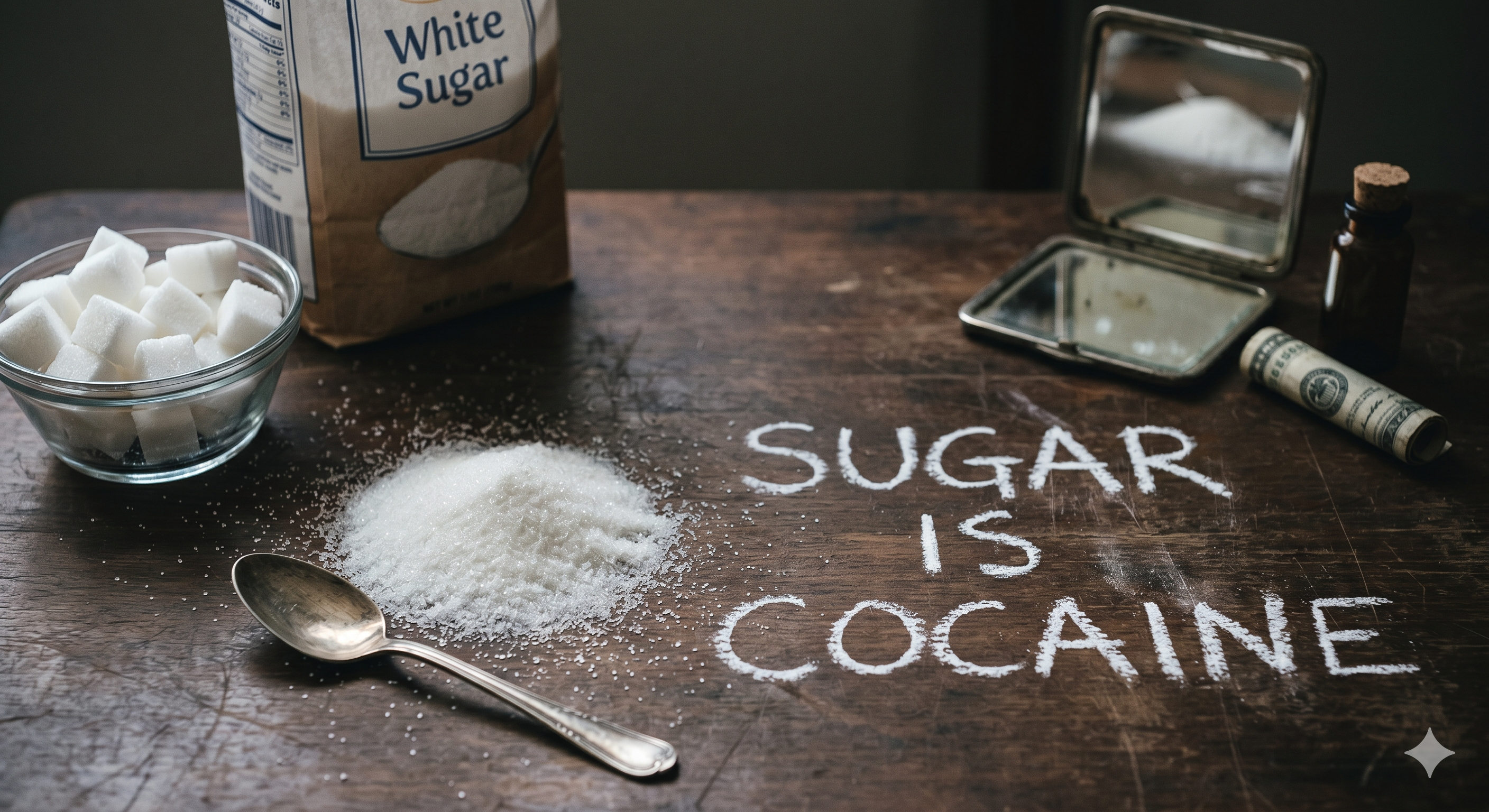
Sugar is evil. Sugar is addictive. Sugar is basically cocaine. Sugar is the reason you are overweight.
You have heard all of it. It is everywhere. Wellness influencers say it. Headlines scream it. Documentaries dramatise it. And at first glance, it feels like it must be true because you genuinely cannot stop eating certain foods and sugar seems like the obvious culprit.
But what if the whole story is wrong?
What if sugar is not the villain it has been made out to be, and the real reason you overeat certain foods is far more nuanced than a single ingredient?
Let us go through this properly, from the beginning, with no fear mongering and no agenda.
What Even Is the Sugar Addiction Argument?
The idea that sugar is addictive became popular largely because of rodent studies. Researchers gave rats unlimited access to sugar and observed what looked like addictive behaviour, compulsive consumption, withdrawal symptoms, escalating intake over time.
The headlines ran with it. Sugar is as addictive as cocaine. Sugar lights up the same reward pathways in the brain as drugs. Sugar is a poison.
And then human research arrived and complicated the entire narrative.
Here is the thing about rodent studies. They give us valuable clues. But rats are not humans. Rats do not eat birthday cake at a party. They do not reach for chips while watching television. They do not eat emotionally after a stressful day at work. The context of human eating is incomparably more complex than anything a rodent study can capture.
When researchers actually studied food addiction in humans using validated questionnaires on over 1,400 people, something very revealing emerged. And it did not point to sugar.
What the Human Research Actually Found
A large study asked participants to identify which foods they struggled most to control their intake of and which foods were associated with addictive like eating behaviours.
The results were clear. The foods people genuinely struggled with were not sugary foods on their own. They were high fat savoury foods like chips, fries, and cheese. And high fat sweet foods like cake, chocolate, pastries, and ice cream.
Plain sugary foods, think sweets, candy, juice, and dried fruit, were not the primary problem foods. They were actually among the lowest on the list.
Nearly 30 percent of food addiction symptoms were attributed to high fat savoury foods. Around 25 percent to high fat sweet foods. Plain sugary foods were far behind.
And crucially, higher body weight was associated with problems specifically around high fat savoury and high fat sweet foods, not foods that were mainly sugar.
So when people say they are addicted to sugar, what they are almost always actually describing is an inability to stop eating foods that combine fat and sugar together, or fat with salt and starch. Not sugar by itself.
Think about that for a second.
The Sugar Cube Test Nobody Thinks About
Here is a simple thought experiment that cuts through the noise immediately.
When did you last sit down and eat sugar cubes one after another, unable to stop? When did you last binge on plain hard candy until you felt out of control? When did you last eat a bowl of plain white rice and feel like you needed more and more even though you were full?
You probably have not. Because plain sugar, on its own, is actually not that compelling.
Now compare that to potato chips. Or a warm chocolate chip cookie. Or a slice of pizza. Or a creamy pasta dish.
These are the foods people genuinely struggle to moderate. And what do they all have in common? They are combinations. Fat plus starch. Fat plus sugar. Fat plus salt. Fat plus crunch plus a satisfying texture in your mouth.
This is not an accident. Food scientists actually work to find what they call the bliss point, the precise combination of fat, sugar, salt, and texture that makes a food as rewarding as possible. These foods are engineered to override your normal fullness signals. They are designed to keep you eating.
The problem was never sugar alone. The problem is hyperpalatable food.
What Makes a Food Hyperpalatable
Hyperpalatable simply means extremely rewarding and very easy to overeat. And it is not just about taste. Several factors combine to make certain foods nearly impossible to eat in moderation.
The combination of fat with either sugar or salt creates a reward response in the brain that neither fat, sugar, nor salt creates individually. This is why a donut is harder to stop eating than a spoonful of sugar. The donut is fat plus sugar plus a soft yielding texture. Every element amplifies the others.
Texture and mouthfeel play a huge role that most people never consider. Soft, moist, and creamy foods are more rewarding than rigid or dry ones. This is partly why Greek yogurt and cottage cheese, which are actually incredibly nutritious, get rejected by so many people. The texture does not feel rewarding enough. Meanwhile a chip, which dissolves quickly and delivers instant salt and fat, barely registers as food before you have reached for another.
Salt deserves its own mention here. Salt has zero calories. It is not a macronutrient. And yet the right amount of salt transforms an ordinary food into something compulsive. This is why a plain unsalted cracker feels flat while a salted one is hard to put down.
There is also something called sensory specific satiety. Your body can feel full from one type of food and yet immediately want another. You know this feeling. You finish dinner, you are stuffed, and then someone brings out dessert and suddenly you have room. That is not weakness. That is your brain responding to a new sensory experience. Your fullness is specific to what you just ate. A different flavour, texture, or food category resets the signal.
But What About the Cocaine Comparison?
This one gained massive traction because of a study showing that rats, when given the choice, preferred sweet water over cocaine. The headlines turned this into sugar is more addictive than cocaine.
But here is what those headlines left out.
The rats preferred sweetness when cocaine had a delayed delivery and sweetness arrived faster. When researchers removed the time delay, cocaine preference went up significantly. The rats were not choosing sweetness because it was more rewarding in the same way cocaine is. They were choosing what arrived faster in the moment.
Furthermore, cocaine is more addictive than sugar in humans by every meaningful measure. Cocaine causes genuine physical dependence, withdrawal symptoms, escalating compulsive use despite severe consequences, and long term neurological changes. Sugar does not meet the clinical criteria for addiction in humans. No serious addiction researcher classifies it that way.
What sugar and palatable food do is activate the same reward pathways that drugs use. But activating a reward pathway is not the same as creating addiction. Exercise activates those same pathways. Music does. Social connection does. The existence of a reward response does not make something a drug.
Here is perhaps the clearest argument against sugar addiction in humans. Nobody struggles to stop eating fruit. Fruit is loaded with sugar. If sugar were genuinely addictive in the way cocaine is, fruit would be a public health crisis. It is not. Nobody is bingeing on oranges.
What people binge on is chocolate, chips, pizza, cookies, and ice cream. Foods that happen to contain sugar alongside fat, salt, and rewarding textures. The sugar is not the driver. The combination is.
So Why Do You Feel Out of Control Around Certain Foods?
This is the real question, and it deserves a real answer.
Your brain is wired to seek out calorie dense, rewarding foods. This is ancient biology. For most of human history, calorie dense foods were rare and finding them was survival. Your reward system was built to drive you toward them hard because the alternative was starvation.
The problem today is that your biology has not changed but your food environment has completely transformed. You now live in a world where the most calorie dense, most rewarding, most expertly engineered foods in human history are available everywhere, at low cost, in enormous portions, at any hour of the day.
Your brain is running ancient software in a modern environment. It was never designed to say no to a bag of chips that combines the perfect ratio of salt, fat, and crunch in a light dissolving texture that barely registers before the next one is in your hand.
This is not a character flaw. It is not weak willpower. It is biology meeting a food environment that is specifically designed to override your natural satiety signals.
What the Research Says You Should Actually Do
The evidence consistently points to a few practical truths that are worth internalising.
True food addiction, if it exists at all in a clinical sense, is almost entirely associated with foods that combine fat with either sugar or salt, not sugar alone. This means the binary of good foods versus bad foods, clean versus dirty, sugar versus no sugar, is not how your body or your brain actually works.
A comprehensive review on the topic concluded clearly that sugar is not addictive in the way classical drugs are. What the evidence does support is that high fat sweet and high fat savoury foods are significantly easier to overeat and are more associated with loss of control eating than any other food category.
There is also a strong and consistent link between depression symptoms and food addiction behaviours. Emotional eating is real, it is common, and it is often what is actually driving the feeling of being out of control around food. Treating the psychology without addressing the underlying emotional state rarely produces lasting change.
What This Means for Your Diet in Practice
If your goal is fat loss, the foods most likely to sabotage your calorie deficit are not the ones with the most sugar. They are the ones that combine the most fat with the most reward. Highly processed foods that deliver fat, salt, sugar, and texture together in one package are the ones most likely to push you past your intake goals without you realising it.
That does not mean you can never eat them. It means you need to be honest with yourself about whether you can moderate them. Some people can keep a bag of chips in the cupboard and eat a small portion. Others cannot and know it. Neither is a moral failing. It is just individual variation in how reward sensitive your brain is.
If you know certain foods reliably lead to overeating, removing them from your immediate environment is not restriction. It is just smart. You are not testing your willpower every time you open the cupboard. You are removing the need for willpower entirely.
If you can eat chocolate in moderate amounts and move on with your day, you do not need to eliminate it. The all or nothing thinking around food, where a single biscuit means the diet is ruined, causes far more damage than the biscuit itself.
And if you are someone whose eating feels genuinely out of control, particularly if it is tied to low mood, stress, or emotional distress, that is worth exploring with a professional. The food is rarely the root cause. It is usually the coping mechanism.
The Bottom Line
Sugar is not poison. It is not cocaine. It is not the single cause of the obesity epidemic and it is not uniquely addictive in the way that drugs are.
What the evidence actually shows is that the foods most associated with overeating and loss of control are those that combine fat with sugar, or fat with salt and starch, in ways that light up the brain’s reward system more powerfully than any single ingredient ever could.
Your biology was designed to seek out calorie dense, rewarding foods. The modern food industry was built to exploit exactly that. The result is an environment where overeating is the path of least resistance and your brain is working against your goals before you even open the packet.
Understanding that is not depressing. It is actually liberating. Because it means the solution is not hating yourself for lacking willpower around food that was literally designed to override your self control. The solution is building a food environment and an eating pattern that works with your biology rather than constantly fighting it.
Stop fearing sugar. Start understanding what actually drives you to overeat. That is where the real work begins.
REFERENCE:
https://pubmed.ncbi.nlm.nih.gov/32731253/