








Introduction
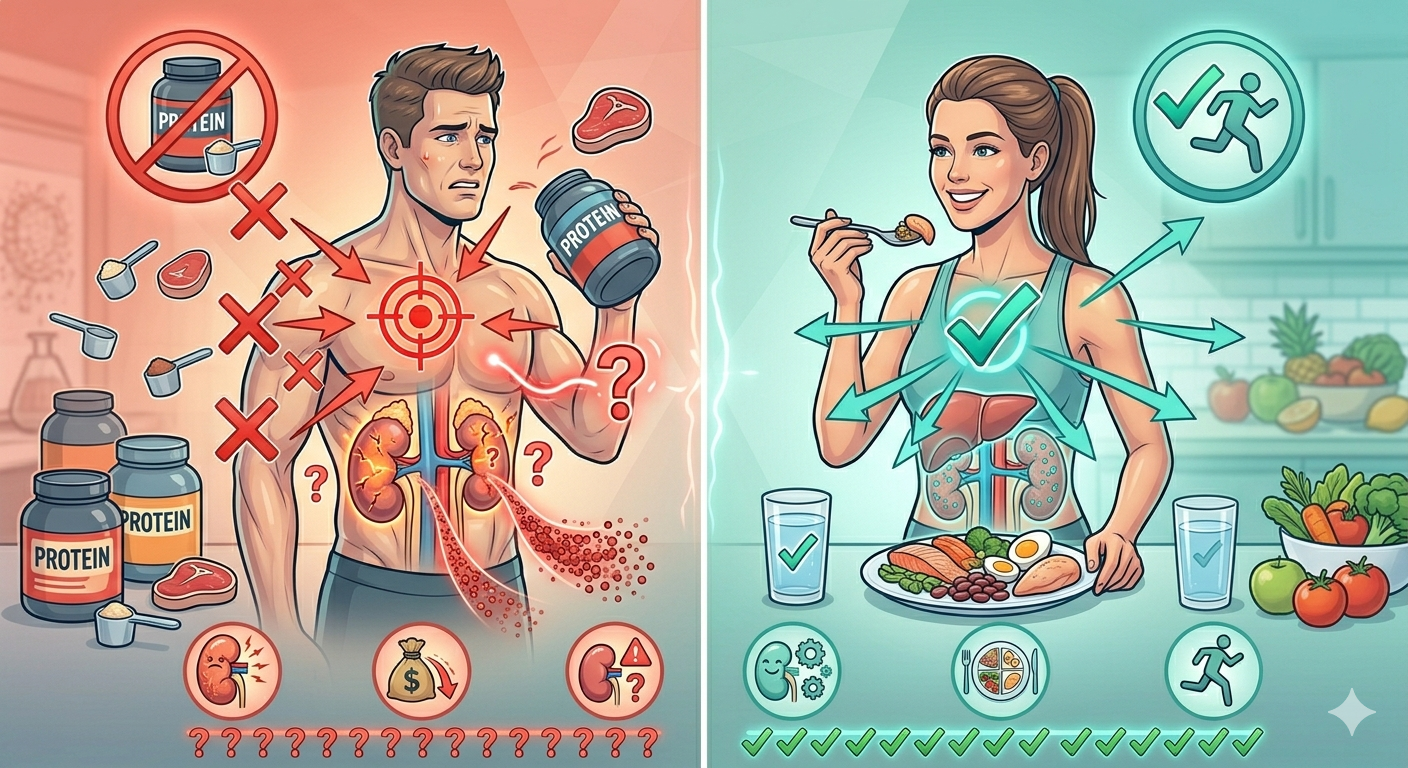
Protein has quietly become one of the most misunderstood nutrients in modern nutrition. On one side it is praised for building muscle, supporting fat loss, and preserving strength with age. On the other, it is blamed for overworking the kidneys and supposedly causing long term damage. The concern sounds logical — when we eat protein, our body breaks it down into amino acids, nitrogen containing waste products are formed, and the kidneys filter and excrete those byproducts. So the assumption becomes simple: more protein means more kidney work, which must eventually mean kidney damage. But human physiology does not work on assumptions. It works on evidence.
What Protein Actually Does in the Body
Protein is not just about muscle. It is structural and functional across nearly every system in the body. It supports muscle repair and growth, enzyme production and metabolic reactions, hormone synthesis, immune defense, tissue repair, and the preservation of lean mass as we age. Adequate protein intake is strongly associated with better body composition, improved satiety, and protection against age related muscle loss. In older adults especially, higher protein intake is often protective rather than harmful.
Given how central protein is to human biology, the claim that it quietly damages healthy kidneys deserves serious scrutiny. The fear has been repeated so often and for so long that it has taken on the feel of established fact. It is not.
Where the Kidney Damage Theory Came From
The fear traces back to the 1980s and something called Brenner’s hyperfiltration theory. The theory proposed that higher protein intake increases glomerular filtration rate, a marker of how well the kidneys filter blood, and that over time this elevated filtration could damage kidney structures. It is true that eating more protein increases GFR. But an increase in GFR is not automatically damage. It can simply represent a normal adaptive response, much like your heart rate increases during exercise.
The real question is not whether protein increases filtration temporarily. The real question is whether this leads to long term decline in kidney function in healthy people. That is where the research becomes critical, and that is where the theory falls apart.
What Large Reviews and Meta Analyses Show
Researchers at McMaster University conducted a comprehensive meta analysis examining 28 studies published between 1975 and 2016, covering more than 1,300 participants who were healthy, obese, or living with type 2 diabetes or hypertension, none of whom had chronic kidney disease. High protein intake in these studies typically meant at least 1.5 grams per kilogram of bodyweight per day, at least 20 percent of calories from protein, or at least 100 grams per day. The conclusion was clear. There was no evidence linking high protein intake to kidney damage in healthy individuals. Higher protein intake increased GFR in a way that reflected normal physiological adaptation, not pathology.
A 2018 systematic review specifically analysed changes in GFR over time at intakes between 1.2 and 3.3 grams per kilogram per day and again found no adverse effect on kidney function. A separate 2018 meta analysis reached the same conclusion in healthy adults. Across decades of research, no progressive kidney damage has been demonstrated in healthy individuals consuming higher protein diets.
What About Very High Protein Intakes?
Some resistance trained individuals consume well above average protein intakes, sometimes exceeding 2 grams per kilogram daily. In one six month randomised crossover study, resistance trained men consuming approximately 3.3 grams per kilogram per day showed no harmful changes in kidney or liver function. In a two year case observation of trained men consuming up to 3.5 grams per kilogram per day, no negative kidney outcomes were observed.
These intakes exceed what most people consume, yet kidney markers remained stable throughout. If high protein truly caused kidney damage in healthy individuals, these populations would show clear signals. They do not. The International Society of Sports Nutrition has reviewed this topic extensively and their position is direct: high protein intake does not cause kidney damage in healthy individuals. The World Health Organization has similarly indicated there is no evidence linking high protein intake to renal disease in healthy populations.
When Caution Does Apply
The conversation changes in the presence of chronic kidney disease. In individuals with diagnosed kidney impairment, protein restriction is often recommended as part of medical management, and most guidelines suggest intake near the recommended dietary allowance of about 0.8 grams per kilogram per day. However, even here nuance exists. Many patients with kidney disease struggle with protein energy wasting and muscle loss, and in some cases slightly higher intakes may be appropriate under medical supervision to prevent frailty.
The key distinction is simple. Protein does not cause kidney disease, but it may need to be managed once kidney disease already exists. For individuals with only one kidney, data is limited and some experts recommend keeping intake around 1 gram per kilogram as a cautious approach, though strong evidence defining an upper limit is lacking. These are clinical exceptions, not rules that apply to the healthy general population.
The Bottom Line
The belief that high protein diets damage healthy kidneys has existed for more than half a century. Yet repeated systematic reviews, meta analyses, and long term studies consistently fail to show harm in healthy adults. Yes, protein increases kidney filtration. That is normal adaptation. It is not injury. If you are healthy and consuming protein within common athletic ranges, typically between 1.2 and 2.2 grams per kilogram per day, there is no scientific evidence that you are harming your kidneys.
Meanwhile, inadequate protein intake carries its own well documented risks, including loss of lean mass, reduced metabolic rate, and increased frailty with age. For healthy individuals, protein is not a silent threat. It is a foundational nutrient that supports strength, metabolism, and long term health. The evidence does not support the fear. It supports the context.
Reference:
https://pmc.ncbi.nlm.nih.gov/articles/PMC11022925/